• 01/08/2026

    For me, and for our family, serving overseas has always been part of the plan.  Specifically, to serve at an international school.  This was for pragmatic reasons – it fits our qualifications, experience and giftings.  But also for kingdom reasons, since international schools are a hugely important part of enabling families to go, and to remain, on the mission field.

    Tim and I explored a few different options for how and where, and spoke to a couple of different mission organisations, and other places.  And while the continent we’ve ended up in is not the one we originally had in mind, one thing has remained constant – the who of our calling.

    When God calls parents to work in overseas missions, their children immediately acquire a new facet of their identity – they become Third Culture Kids.

    A formal definition of the term: a Third Culture Kid (TCK) is a person who spends a significant part of his or her first eighteen years of life accompanying parents into a country that is different from at least one parents’ passport country, due to a parent’s choice of work or training. 

    There are different “subsets” of TCKs (missionary kids, embassy kids, kids from military families or whose parents work for international businesses/NGOs…) and while each child and each family and each family situation is unique, there are common challenges and blessings that come from being a TCK, regardless of which subset you belong to, or what your specific circumstances are.  These challenges have been known of anecdotally for a long time (and the term TCK itself has been around at least since the late eighties), but more recently, have begun to be studied and written about more systematically.

    In her wonderful and highly readable book “Raising Up a Generation of Healthy Third Culture Kids” (2020), Lauren Wells talks about the ampersand (&) nature of TCK life.  That growing up as a TCK is a both/and situation – wonderful and difficult.  Joy-filled and grief-filled.  So good and so hard.

    TCK life provides many wonderful opportunities – opportunities to have incredible experiences, to develop character and skills, and to acquire cool stories.  Some of the good things that can come out of the TCK experience are: the development of a global perspective, of adaptation and language skills, of high emotional intelligence and empathy levels, of resilience and hope, of a complex identity, and of healthy self-confidence.

    But there are also common challenges in TCK life, particularly:

    • Grief and loss
    • Trauma
    • Toxic stress
    • Difficulty with identity formation
    • A sense of not belonging anywhere
    • Difficulty sustaining deep, meaningful relationships
    • Difficulty settling down/a high need for change

    These challenges interweave with and feed off each other.

    Many of the difficult experiences in TCK life cannot be prevented, but are simply part of the life that their family signed up for, especially for TCKs living in developing or unstable nations. 

    Challenges are in and of themselves not always a bad thing.  Many of the character traits that we want for our children are forged and refined through trial.  There are no shortcuts to moral development.

    Ultimately, the good is real, and the bad is real, and both of them have a very real impact on the mental health and wellbeing of these kids, both now and in their future adult lives.

    During discussions with one mission organisation, I made the comment that I was not willing to sacrifice my family for the sake of the mission.  This did not go down well.  While I am completely onboard with not making an idol out of family, I think that being asked to choose between a successful mission and a successful family is a false dichotomy.

    Yes there will be sacrifices, and hard choices may have to be made.  But I return again to Lauren Wells’ ampersand.  Family AND mission.  Find a way for both.

    As we work at KISC, we play a small part in helping missionary parents to find the ampersand too.  So that they can work in the roles God has called them to here in Nepal (creation care, social justice, church leader training, etc), AND be part of a community where their children will be supported to flourish, so that the griefs of TCK life can be minimised, and the joys maximised.  Through our presence and our engagement, we demonstrate to TCKs that the family’s mission matters AND they as individuals matter, to us and to our Heavenly Father.

    What a joy, and what a privilege.

    Alex

    References

    “Raising Up A Generation of Healthy Third Culture Kids: A Practical Guide to Preventative Care” by Lauren Wells (2020)

    “Third Culture Kids (3rd Edition): Growing Up Among Worlds” by David C. Pollock, Ruth E. Van Reken, & Michael V. Pollock (Nicholas Brealey, 2017)

    “Belonging Everywhere and Nowhere: Insights into Counselling the Globally Mobile” by Lois J. Bushong (Mango Tree Intercultural Services, 2013) My own brain

  • 19/07/2026

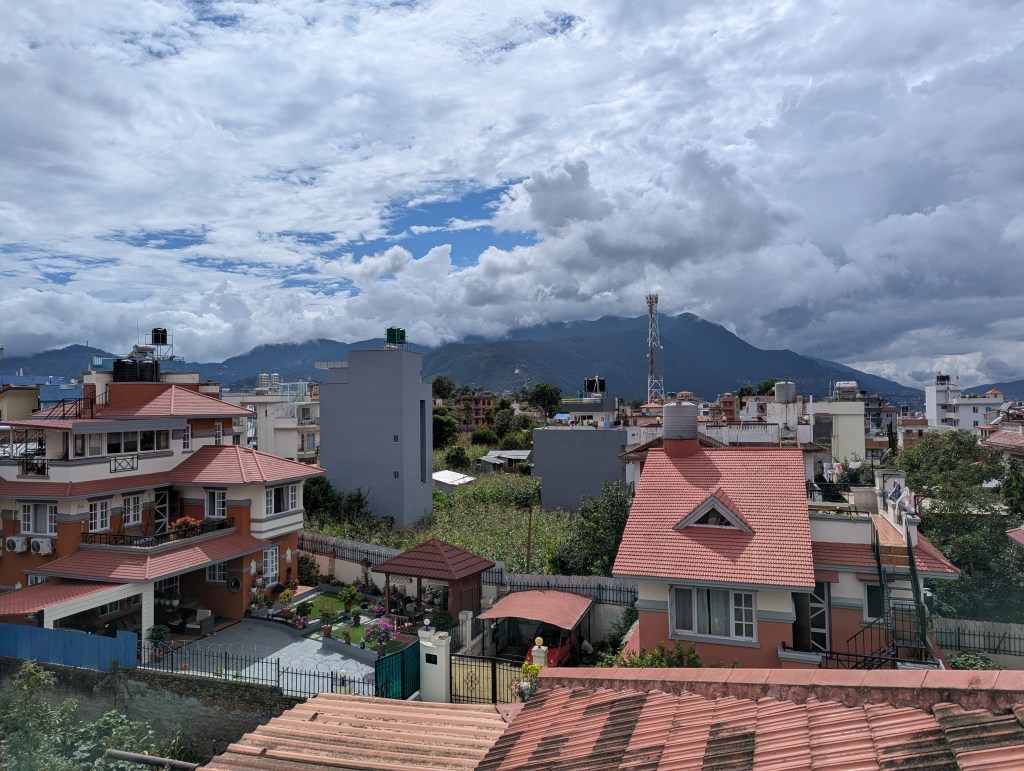
    (Photo taken from the roof of our house)

    It is Sunday, and the song of the last few days has been the first section of Matt Redman’s 10 000 Reasons.

    The sun comes up
    It’s a new day dawning
    It’s time to sing your song again
    Whatever may pass and whatever lies before me
    Let me be singing when the evening comes

    We flew out of Sydney on Thursday evening, had a ten hour stopover in Delhi, and arrived in Kathmandu Friday evening, into the chaos of Kathmandu traffic. It’s a constant barrage of beeps, with cars and motorbikes/scooters and buses and bikes weaving in and out of each other, all over the road.

    Our new home is in the south of Kathmandu, in a gated community a few minutes walk away from the school. It’s a small oasis of calm. We had bought quite a lot of bits and pieces from the teachers who lived here previously, so we immediately had most of things that we needed – such as furniture and cutlery, washing powder for our first load of washing, and Wifi, which was such a wonderful blessing. That evening, and the following day, of the teachers showed us to a small supermarket, and another teacher took us to a market stall to get some fruit and vegetables. We walked the scenic route back, and saw chickens, cows, goats, sheep, ducks, and so very many street dogs.

    Today after church a fellow Aussie expat helped us catch the bus to the major department store, where we were able to buy towels (no more sharing one communal towel, hooray) and a stool (for the kids to be able to reach the many high up door latches) and a rice cooker.

    Soon Tim will pop out again to buy vinegar for washing fruit and vegetables, and then we’ll settle for a quiet afternoon. We still have to get our local SIM cards activated, and set up Nepali bank accounts.

    There is a lot that is overwhelming, and will probably continue to be overwhelming for a while. I tried to learn the Nepali word for thankyou, but my brain is so full that it won’t stick. Each one of us has things that we are finding particularly hard, but the kids are doing so, so well.

    But by grace, we’re still singing.

    Alex

  • image from Magnific

    Not always, but often, I wake up with a worship song in my head.  Over the last few weeks, the song “Great Is Thy Faithfulness” has been featuring quite a lot.  It plays as I wake, and as I head downstairs to get on with the morning jobs.

    I have not felt particularly productive over this season of packing.  This is an unpleasant feeling, because I am accustomed to being Productive and Organised and Capable.  A Very Useful Engine, as the Fat Controller would say.

    It’s not a bad thing for me to be reminded (again) that this is not where my worth comes from.  However, I would prefer to (re)learn this at some other time, and not when our international move is less than two weeks away.

    As we sort out our household, among the things that I can easily get rid of, and the things that I box up, there are other things that I pause over.  Boxes I haven’t looked in since we moved to this particular house four and a half years ago, with diaries from my teenage years, letters from friends I haven’t seen in a couple of decades.  A bundle of cards from when I was born, welcoming me into the world.  I only have so much time to sort uninterrupted while the kids are at school, but I use some of it to sit and look through them, looking for names I recognise.  I sit surrounded by love.  Also dust.  But mostly love.

    Over the last few months, we have felt loved and supported by our families and friends and by our church in a way that has, at times, surprised us.  Our initial uncertainty around sharing this next chapter, and around asking for support as we seek to follow God’s call, met with openness and warmth.

    We are surrounded by love.

    And through it all, God’s faithfulness.

    Jehovah Jireh.  The God who provides.

    Through the love that surrounds us and bolsters us up with encouragement and reassurance.  Through the love that practically engages with our needs.

    His loving mercies sustain those little engines zipping smoothly through their to-do lists, and the overwhelmed ones who don’t feel so very useful right now.  And each morning they are new again.

    Alex

  • (trunks downloaded from Creative Market years ago, coloured in Gimp)
    AC Photography

    04/06/2026

    As of today, there are six weeks to go until we leave. There’s still a lot to pack (most of it, really). Aside from a few packing boxes here and there, and a few gaps where there didn’t use to be gaps, our home looks mostly the same as it usually does. But the lasts are steadily rolling in. Last sessions with clients. Before long, the last swimming lesson, the last riding lesson, the last day of school. I’m thankful to only be working part-time, but even still my brain is feeling very full.

    I remember times I’ve sat with clients who were struggling in the in-between seasons and spaces of their lives. Humans don’t like liminal. We like to be here, or there. We don’t like trying to straddle here and there simultaneously.

    There’s probably a sermon illustration in there.

    Next up is compiling the stuff we want to freight over. We’re trying to minimise what we bring, and stick to the essentials. Which for our family is books and board games and Lego, mostly. With maybe some clothes to fill the gaps.

    Sometimes when I am feeling overwhelmed I make lists of our carry-on luggage, contemplate which book(s) I will carry with me squeezed in among the baby wipes (aeroplane tray tables = germ city) and notebook and pencils and card games (for the long hours in the airport) and laptop and change of clothes. Tish Harrison Warren’s “Prayer in the Night” (IVP, 2021) of course, but what else?

    But I do have a while to decide, I suppose.

    Alex